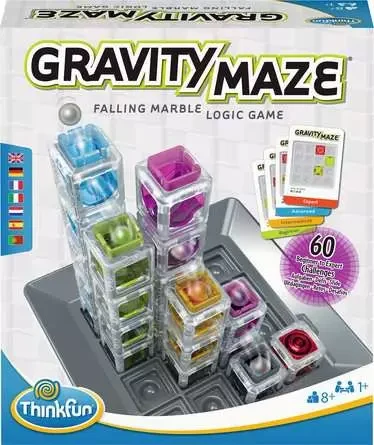
Our verdict: The original ThinkFun Gravity Maze is a good candidate for a child who enjoys following a puzzle’s constraints, trying a construction and adjusting it when the marble goes the wrong way. It is less convincing for someone who wants a large free-building marble run or an activity with no rules to learn. Buy it for the process of solving; the age label alone cannot tell you whether a particular child will enjoy that process.
Research-based review, checked November 21, 2026. We have not personally tested Gravity Maze, and Anthony has not reported owning it. Product facts come from Ravensburger/ThinkFun and the manufacturer instructions. Historical family experiences are attributed below. We do not claim measured learning benefits, durability testing or personal play sessions.
Affiliate disclosure: We may earn a commission from our Amazon links. As an Amazon Associate I earn from qualifying purchases.
Amazon model search: original ThinkFun Gravity Maze, 60 challenges. An exact current ASIN has not been verified. Match the original game, which Ravensburger currently lists as article 76433, rather than assuming Gravity Maze Builder or Gravity Maze Slide is identical.
Who it suits and who should skip it
Consider it for a puzzle enthusiast who likes testing an idea in a physical model. The product is listed for one player and ages eight and up. An older child, teen or adult who likes this style of puzzle may also be interested, but that is a preference judgment rather than a guarantee of suitable difficulty.
Skip it for a child expecting a sprawling track set, a group competition or immediate action without interpreting a challenge card. Think about the household too: the marbles and small components need a controlled play area and secure storage away from younger children. A recommended play age does not remove those considerations.
What is in the original game?
| Published contents or feature | What it means for the buyer |
|---|---|
| Grid, nine towers and one target piece | The puzzle uses a defined set of building parts, rather than an unlimited track system |
| Three marbles | The original instructions identify one for play and two spares |
| 60 challenge cards, beginner to expert | There is a finite supplied progression, with difficulty choices |
| Solutions provided with the challenges | A way to check a difficult setup without an app |
Check the box contents on arrival, especially if buying used. An inexpensive incomplete set can be a poor gift if a required tower or the challenge cards are missing. We have not verified compatibility of parts across the separately named Gravity Maze products.
How the puzzle actually works
The instructions ask the player to reproduce a starting arrangement, then use the specified additional towers to make a path from the starting point to the target. Placement and orientation matter. A construction that looks plausible from above may send the marble through a different opening than expected.
This gives the activity a clear feedback loop: choose a route, build it, release the marble and inspect what happened. That is our explanation of the task, not a claim that the game produces a particular educational outcome. We are not promising better school performance or improved cognitive scores.
The building rules are part of the challenge. The instructions restrict moving the preset pieces, limit stack height and impose support requirements on horizontal towers. A marble reaching the target is not the whole test if the construction breaks the puzzle’s rules. An adult explaining the first few examples should cover that distinction rather than only showing the final solution.
What historical independent reports add
Jonathan H. Liu’s September 2014 GeekDad review described his children repeatedly running marbles through solved constructions and one child revisiting the cards after finishing them with some help. ThinkFun supplied his review sample, a disclosure worth retaining when judging the evidence. This is his family’s experience with an earlier retail-era copy, not our observation of a current box.
The Board Game Family’s 2014 review offers a different useful detail: its child reviewer initially found beginner challenges too easy and became more interested after trying a harder card. The family also described making puzzles for one another. That suggests trying a suitable difficulty before dismissing the game, but it does not establish how quickly another child will progress.
Neither account should be turned into a universal age or attention-span claim. Both are historical reports, checked against the current publisher’s original-game description and contents. We have not inspected current production quality or reproduced those play experiences.
The meaningful drawbacks
- Rules and orientation create setup work. Someone has to read the card correctly. Misplacing a starter piece can turn a reasonable challenge into unnecessary frustration.
- One player’s task can become a spectator activity. Although others can discuss a solution, the listed game is not a conventional multiplayer competition. A family wanting simultaneous participation should choose accordingly.
- The supplied puzzle count is finite. Remembering a solution changes the experience. Inventing new constructions may extend interest, but not every child will want to do that.
- Loose pieces need managing. Marbles can roll away and cards can become separated from the game. It is better suited to a stable table than an uncontrolled floor or a moving vehicle.
These are purchase implications of the format, not failures we observed in a test. A child who enjoys deliberate trial and error may welcome the same constraints another child dislikes.
Age suitability and adult involvement
Start with the manufacturer’s eight-plus recommendation and the child’s actual interests. It does not mean an eight-year-old will solve all the challenges unaided, or that an older child will find them too easy. Offer help with understanding the diagrams before taking over the solution.
For a shared gift, decide who will explain the instructions and where unfinished work can stay. A short session might end with a partly built puzzle; a clear table and a place for the selected pieces make resuming easier. We are not estimating a typical completion time because we have not measured one.
The marbles present a choking hazard. Keep them and other small components away from younger children and anyone who may mouth objects. Read the warning label on the actual package rather than treating the recommended play age as a substitute for household safety decisions.
Upkeep, missing pieces and support
No battery, account or subscription is needed for the physical game. The main upkeep is keeping the parts, cards and instructions together. Count them before putting the game away, and do not improvise replacement marbles or components without confirming suitability with the manufacturer.
Ravensburger’s US Care Commitment offers a 365-day replacement process for eligible products bought directly or from authorized sellers, limited to the original end-user purchaser and subject to the stated conditions. It asks for seller and purchase information and may request proof or photos. For ThinkFun products it says full replacements can generally be provided, while individual pieces cannot generally be supplied through that process.
This is not a promise of lifetime replacement marbles or an automatic refund. If bought from a retailer, Ravensburger asks customers to check that retailer’s policy first. Keep the receipt and contact support promptly about an incomplete or defective gift. Do not assume every marketplace seller qualifies.
Alternatives based on the child’s expectations
If the child wants to design long tracks without challenge-card restrictions, compare a free-building marble-run system with its own age and small-parts guidance. If the interest is constructing a model to display, a building set may be a closer match; our LEGO T. rex 31151 review explains that different kind of activity. Check current model status and seller terms before choosing an older set.
If a group game is wanted, use a title designed for the intended number of players rather than assuming a solo puzzle will serve the same purpose. Borrowing a copy, where available, is a useful way to test the format before buying. We are not claiming a local library has stock.
Our gift recommendation
Choose original Gravity Maze when the recipient likes a bounded problem, enjoys making adjustments and has a suitable place to use and store small pieces. Pair the box with an offer to learn the first challenge together. Skip it when a different activity would better match the child’s wish list.
No live exact-model Black Friday offer, holiday return extension or Christmas delivery has been verified here. This review avoids prices and discount claims. For other completed guides, visit our Christmas gift hub.
Sources and limits
Checked November 21, 2026. Scoped CPSC searches did not surface a matching Gravity Maze recall; this is not an exhaustive safety clearance. No product photographs are reproduced because exact-product image rights were not established.
- Ravensburger/ThinkFun original Gravity Maze, article 76433: age, players, contents and challenges.
- ThinkFun original manufacturer instruction sheet, hosted on Amazon’s document CDN. The original PDF was checked; third-party text conversions can misread diagrams and counts.
- Ravensburger US Care Commitment and eligibility conditions.
- GeekDad, Jonathan H. Liu, September 2014, disclosed brand-provided sample; The Board Game Family, November 2014; CPSC recall database.
Leave a Reply
You must be logged in to post a comment.